profile

Praveen Kumar K 👋

Senior UX/UI Architect & ✦ AI Agentic Design Strategist with 18+ years of experience across 14+ countries. Expert in HCI, Behavioural UX, Generative AI & Enterprise Design Systems.
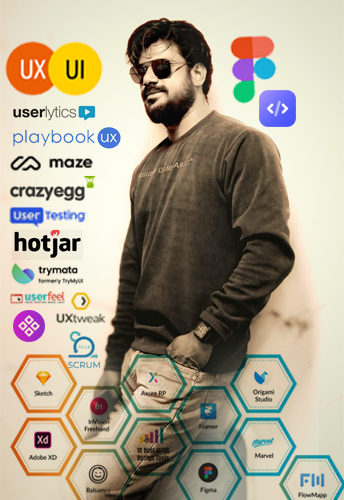
Expert In

Available For Hire
Strategic Design Leadership

Strategic Design Leadership

Team Leadership & Mentorship

Team Leadership & Mentorship

Workflow Management

Workflow Management

Design Operations

Design Operations

Cross-Functional Collaboration

Cross-Functional Collaboration

Design System Governance

Design System Governance

UX Research & Validation Leadership

UX Research & Validation Leadership

Agile & Product Lifecycle Alignment

Agile & Product Lifecycle Alignment

Communication & Stakeholder Influence

Communication & Stakeholder Influence

Project & Resource Management

Project & Resource Management

Hiring & Scaling Teams

Hiring & Scaling Teams

 Quality & Design Review

Quality & Design Review

 Business Acumen & Data Fluency

Business Acumen & Data Fluency

ui-ux

UI UX Design

app

Mobile App

prd-design

Product Design

branding

Branding

camera

Photography

youtube

Motion Design

web-development

Web Development

view

Visualization

✦ AI Agentic  Development & Orchestration Stack
Multi-Agent Orchestration

Multi-Agent Orchestration

LangGraph & CrewAI

LangGraph / CrewAI

RAG & Context Engineering

RAG & Context Engineering

Human-in-the-Loop UX

Human-in-the-Loop UX

Azure AI Foundry

Azure AI Foundry

Prompt & LLM Orchestration

Prompt Orchestration

Agent Observability & LangSmith

Agent Observability

MCP & Agentic Protocol Design

MCP Protocol Design

Behavioural UX & Cognitive HCI

Behavioural UX / HCI

Vector DBs Pinecone Weaviate

Vector DB (Pinecone / Weaviate)

AI SDLC & Full-Stack AI Apps

AI-Native SDLC Ownership

AI CoE Leadership

AI CoE & Pod Leadership

blog-img-1

Frequently Asked Questions

A Product Designer needs a broad yet deep skill set that spans design, user experience, business strategy, and technical collaboration. Here's a breakdown of what a product designer needs to know to succeed in modern, cross-functional environments:

  • 🔹 1. User-Centered Design
    • Conducting user research (interviews, surveys, usability tests)
    • Creating personas, journey maps, and empathy maps
    • Understanding accessibility and inclusive design principles
  • 🔹 2. UI/UX Design Skills
    • Wireframing and prototyping (low to high fidelity)
    • Strong grasp of layout, typography, color, and interaction design
    • Designing responsive and adaptive interfaces for multiple platforms
  • 🔹 3. Product Thinking
    • Aligning design decisions with business goals and user needs
    • Understanding metrics like engagement, retention, and conversion
    • Prioritizing features based on impact and feasibility
  • 🔹 4. Design Systems
    • Building and maintaining reusable components
    • Ensuring visual and functional consistency across products
    • Familiarity with tools like Storybook or Zeroheight
  • 🔹 5. Cross-Functional Collaboration
    • Working with product managers to shape features and roadmaps
    • Communicating with developers to hand off specs and clarify behavior
    • Engaging with marketing, sales, and customer support for holistic understanding
  • 🔹 6. Technical Awareness
    • Understanding how designs are implemented in HTML/CSS/JS
    • Knowing technical constraints and how to design within them
    • Collaborating using tools like GitHub, Jira, Zeplin, or Figma Dev Mode
  • 🔹 7. Agile & Lean Methodologies
    • Participating in sprints, stand-ups, retrospectives
    • Designing for iterative releases and MVPs
    • Embracing feedback loops and continuous improvement
  • 🔹 8. Communication & Storytelling
    • Presenting and defending design decisions to stakeholders
    • Creating design documentation and rationale
    • Telling compelling stories through design and data
  • 🔹 9. Analytics & Feedback
    • Using tools like Google Analytics, Hotjar, or Mixpanel
    • Running A/B tests and interpreting results
    • Iterating based on quantitative and qualitative data
  • 🔹 10. Soft Skills & Mindset
    • Empathy, curiosity, adaptability
    • Problem-solving and critical thinking
    • Ability to balance craft with speed and pragmatism

UX (User Experience) Design is the process of creating products that provide meaningful and relevant experiences to users. This involves understanding user behavior through research and usability testing, defining user personas and flows, designing wireframes and prototypes, and ensuring that the final product is both useful and usable.

UX is about the overall experience a user has with a product — how intuitive, accessible, and enjoyable it is. UI (User Interface) focuses on the look and feel — buttons, typography, color, layout. UX is the journey; UI is the visuals along the way.

My process usually includes:
  1. Research – stakeholder interviews, user research, competitive analysis.
  2. Define – personas, user stories, problem statements.
  3. Ideate – brainstorming, wireframes, information architecture.
  4. Prototype – low- to high-fidelity prototypes.
  5. Test – usability testing, iteration based on feedback.
  6. Deliver – final handoff with dev specs and documentation.

I start by defining clear research goals. Then I choose the right method — interviews, surveys, or contextual inquiry. After gathering data, I synthesize it into insights using tools like affinity mapping and personas. The findings guide the design direction and decisions.

I use both qualitative (user feedback, usability testing) and quantitative (task success rate, time on task, conversion rate, NPS) methods. I also collaborate with product teams to track metrics post-launch and iterate based on data.

banner-shape-1
banner-shape-1
object-3d-1
object-3d-2